Has America Crossed the Asshole Threshold?
Civilizations can carry a surprising number of parasites and live. But there’s a line — Rome crossed it, the Gilded Age toed it, and for the first time in history, we can measure it.
Grim Reminder: A Grim Historian is a reader-supported newsletter and depends on your 5$ donations to keep the most depressing politics and history in your inbox. Please consider becoming a paid subscriber or sharing with someone who loves misery.
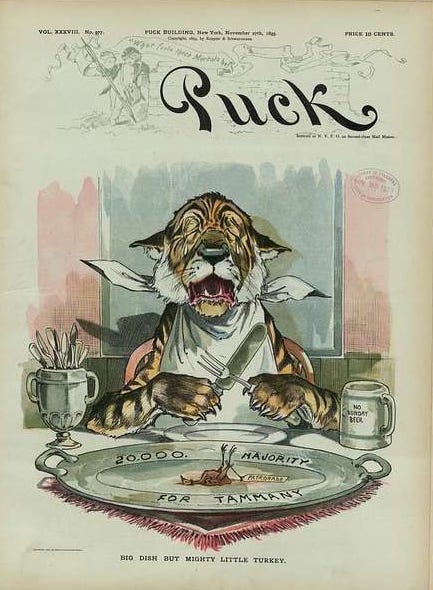
In 1894, a man from Tammany Hall climbed four flights of a Lower East Side tenement carrying a turkey.
Not a metaphorical turkey. An actual turkey. Feathers, legs, the whole Thanksgiving corpse.
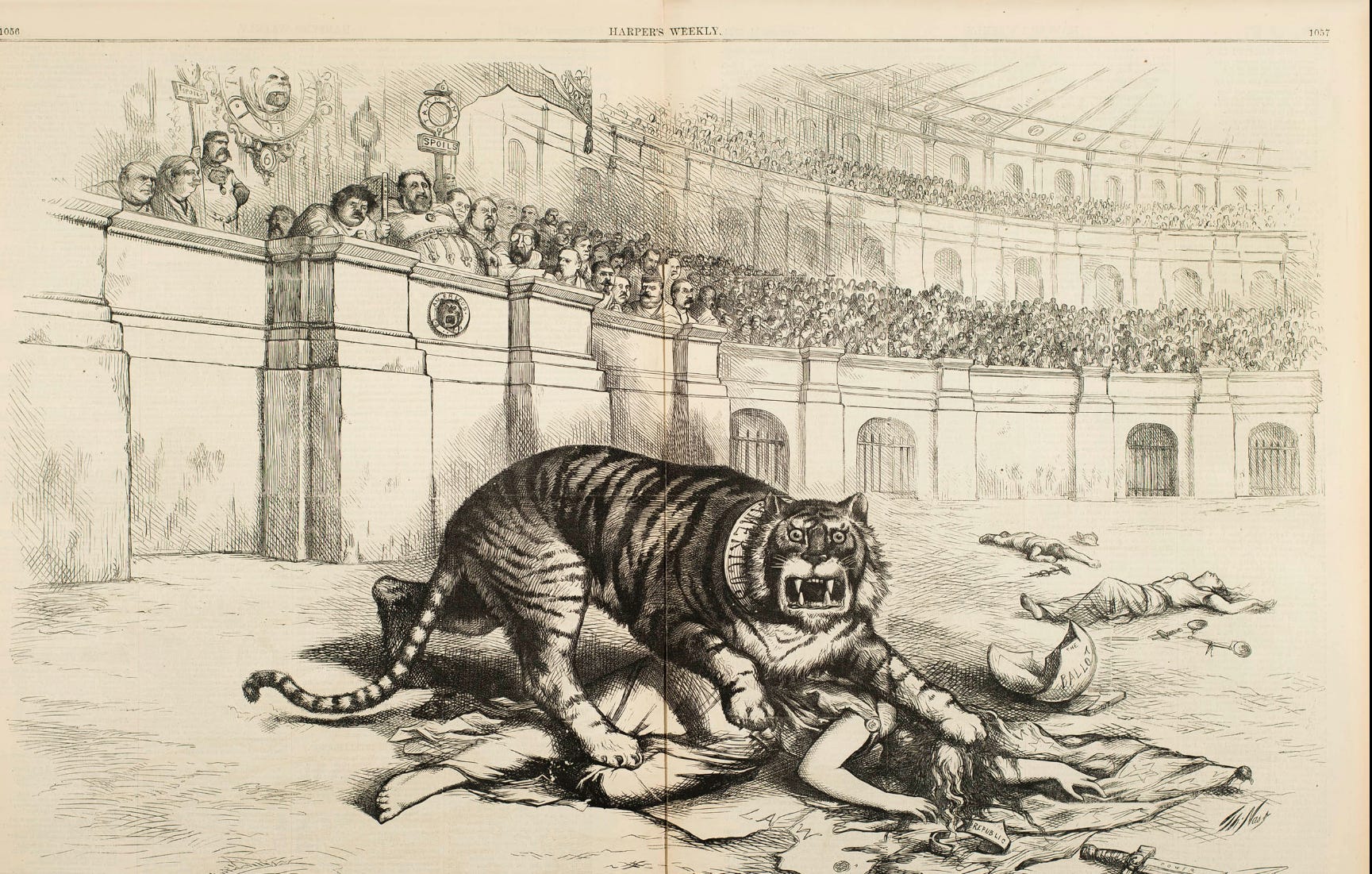
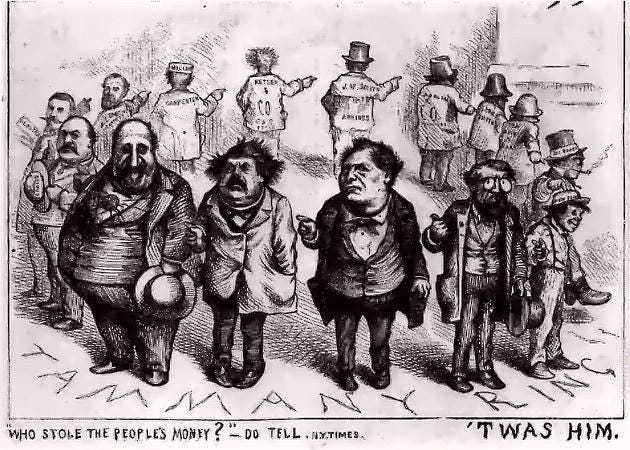
Tammany Hall was New York City’s Democratic political machine, and calling it “corrupt” is like calling the Titanic “damp.” Tammany sold judgeships the way Costco sells rotisserie chickens. It buried building inspections. It let firetraps stand until they burned with people inside. It turned municipal government into a cash register with a flag on it.
And every Thanksgiving, it delivered free turkeys to thousands of poor families across the city.
This particular turkey went to a widow with three children and no husband. There was no welfare in 1894. No Social Security. No food stamps. No unemployment check. If you were poor in New York, there was exactly one organization that might show up at your door with food, coal, rent money, and maybe a job for your oldest kid at the gasworks.
That organization was Tammany Hall.
The deal was never written down because nobody on that stairwell was stupid. Turkey in November. Vote in November. That was the receipt.
She took the turkey. So would you. Don’t lie.
One Tammany boss, George Washington Plunkitt, was so untroubled by any of this that he explained the whole system to a journalist, on the record, cheerfully: “I seen my opportunities and I took ‘em.”
He died rich. The widow did not.
Here’s the part that should bother you. Tammany didn’t steal New York at gunpoint. It bought the city one turkey at a time, from people who understood the Faustian bargain.
Two thousand years earlier, a North African king named Jugurtha rode out of Rome having just bribed a tribune to shut down his own corruption hearing — then arranged a murder while he was in town, for which Rome’s punishment was a polite request to leave. Looking back at the city, he delivered the greatest exit line in ancient history: “a city for sale and doomed to perish if it finds a buyer!”
That line gets quoted as an indictment of the people who sold Rome. It is worse than that. It is an indictment of the buyers.
Jugurtha wasn’t indicting the Senate for being evil. He was indicting them for being cheap. He walked into the mightiest republic in the Mediterranean, expecting resistance. He found a clearance sale.
There is a line. Cross it, and the arithmetic flips. The people gaming the system start to outnumber the people holding it up. Every honest person left standing starts to feel like a sucker. Then that person stops being honest, which moves the line again. Then the next person adjusts. Then the next.
A city can carry a certain number of crooks just as a body can carry a certain number of parasites. It gets pale. It itches. It makes bad decisions. But it lives. Stable societies accumulate these parasitic coalitions — cartels, lobbies, insiders — the way ships accumulate barnacles, each one small, each one rational, until the hull can’t move.
That is the asshole threshold.
Humans have been walking up to this line for three thousand years. Most societies that crossed it died. But a few — a strange, stubborn few — stood at the edge, looked down, and did something that shouldn’t be possible: they turned around. America itself did it once, a little over a century ago, when the country was more corrupt, more violent, and more for-sale than it is now. So what changed?
A coalition of nobodies dragged it back. How they did it is the most important story nobody tells. Because we are standing at the line again — and this time we can measure it.
The Oldest Complaint in Western Literature
Around 700 BCE, a Greek farmer named Hesiod sat down and wrote one of the first burn books of Western literature.
It was a complaint about assholes.
Works and Days is technically a farming manual. It is actually 800 lines of Hesiod telling his brother Perses to stop bribing judges. Perses had sued Hesiod for a bigger share of their father’s estate and won by greasing the local officials.
Hesiod responded the way writers have responded to family betrayal ever since: he made it everyone’s problem. He declared that humanity had degenerated through five ages — gold, silver, bronze, heroes, and finally iron, his own age, where “the father will not agree with his children… men will dishonor their parents… one man will sack another’s city,” and might will make right until the gods abandon us entirely.
Was this true? No. Hesiod was history’s first documented case of a man declaring civilization over because his brother screwed him in probate. But he’d noticed something real, and he was the first to write it down: once corruption pays better than honesty, the downward slide begins.
Three hundred years later, Plato turned the complaint into a theory. Book VIII of the Republic walks through how governments rot from the inside — honor cultures decay into oligarchies, oligarchies breed resentment until they collapse into democracies, and democracies, Plato said, eventually become so distrustful that they hand power to a strongman who promises to fix it all. Plato had watched his own city execute Socrates, so he wasn’t theorizing from nowhere. He was writing a post-mortem.
But the man who turned it into a machine was Polybius, a Greek statesman hauled to Rome as a hostage around 167 BCE. Polybius studied his captors. His conclusion, called anacyclosis, was that every form of government carries its own corruption inside it like an egg — kingship rots into tyranny, aristocracy into oligarchy, democracy into mob rule — and the wheel turns, predictably, forever.
He then politely told Romans that this would happen to them too.
The Romans found this hilarious, right up until it wasn’t.
The Prosecutor Was Also a Crook
Which brings us back to Jugurtha, and to the man who reported his exit line: the historian Sallust.
His thesis: Rome wasn’t being destroyed by Carthage, the Gauls, or any enemy with the decency to attack from outside. It was being eaten by avaritia — greed — which had devoured the mos maiorum, the unwritten civic code that made the whole thing run.
And here’s what makes Sallust essential rather than just quotable: he did not blame the top. He blamed everybody. The mob that sold its votes for grain. The veterans who backed any general promising plunder. The debtors who cheered arson because they had nothing to lose. The respectable citizens who watched conspirators gather an army and did nothing, because civic collapse is fascinating television when you assume you’ll survive the finale.
But here is the part that Sallust’s fans skip: Sallust was one of them.
Before he became history’s angriest moralist, Sallust was expelled from the Senate (officially for immorality). He then clawed his way back as one of Caesar’s men and got appointed governor of a province in North Africa — which he then plundered so thoroughly that he came home facing extortion charges.
He bought his way out, allegedly with Caesar’s help. With the loot, he built a garden estate so magnificent that emperors later confiscated it for themselves. Then he retired and waxed poetic about how greed destroyed Rome. One could call it an autobiography.
You could also call this hypocrisy. Nobody thinks they’re the asshole.
Fourteen centuries later, a Tunisian scholar named Ibn Khaldun — writing after surviving plague, political imprisonment, and every court intrigue North Africa could throw at him — systematized the whole cycle in the Muqaddimah (1377). His engine was asabiyyah: social cohesion, the we-feeling that lets a group act like a group. Dynasties, he found, run through it in about three or four generations.
The founders have it because they had to. Their children maintain it from memory. The grandchildren, raised in luxury, dissolve it into faction and self-dealing. Then some hungry cohesive group from the periphery walks in and takes everything, and the wheel turns.
Hesiod felt it. Plato theorized it. Polybius mechanized it. Sallust prosecuted it (while guilty). Ibn Khaldun put it on a timer. Five civilizations, twenty-one centuries, one diagnosis. The only thing missing was proof.
Then the Mathematicians Showed Up
For most of history, “too many assholes ruin everything” remained a vibe. A well-documented, five-civilization vibe, but a vibe. Then, in the twentieth century, it became math.
It started with Thomas Schelling, an economist who would later win the Nobel Prize. Schelling showed in 1971 that neighborhoods could tip into total segregation even when no individual resident wanted that outcome. Mark Granovetter extended the idea in 1978 to riots and revolts: everyone has a personal threshold for joining bad behavior, and once enough low-threshold people act, they drag the next tier in, and the next. A crowd doesn’t need many instigators. It needs a chain.
But the result that should keep you up at night belongs to Robert Axelrod, a political scientist who in 1980 ran a tournament. He invited game theorists to submit computer strategies to play the Prisoner’s Dilemma — the classic setup where two players each choose to cooperate or cheat. Cheating pays if the other guy cooperates, and mutual cheating leaves everyone poor. Round-robin, hundreds of games, most points win.
The winner was the simplest program submitted: Tit for Tat. Cooperate first. Then do whatever the other guy did last. Be nice, retaliate fast, forgive fast. Decency with teeth beats every sophisticated predator in the pool.
That’s the hopeful half. Here’s the other half. Axelrod’s later work showed that cooperation only survives under certain conditions. Cooperators who are scattered among cheaters get eaten alive — the lone honest man in a crooked ward is not noble, mathematically speaking; he’s lunch.
Cooperators survive by clustering, finding one another, and repeatedly dealing with one another, so honesty compounds. And there’s a threshold: when cheaters get thick enough on the ground that an honest strategy can’t find enough honest partners to break even, cooperation doesn’t decline gracefully. It collapses. The last cooperators defect in self-defense.
Sallust, it turns out, was doing game theory in a toga. He just didn’t have the notation.
And then Peter Turchin, a Russian-American scientist who spent his early career modeling pine beetle outbreaks before deciding humans weren’t meaningfully different, built the database: centuries of records across multiple civilizations, tracking wages, elite numbers, and unrest. His pattern, laid out in End Times (2023): when ordinary living standards stagnate, and too many people fight over too few seats at the top , societies enter what he calls an “age of discord.” His model, built on historical data, flagged the United States years in advance: discord arriving around 2020.
Turchin published the prediction in 2010. Check the tape.
This Time We Can Measure It
Which brings us to the present, and to a research team at UC Davis led by Garen Wintemute — an emergency room physician who spent decades studying gun violence as a public health problem. He reasonably concluded that political violence deserved the same treatment.
In 2022, his team surveyed over 7,000 American adults, a nationally representative sample, and published the results in the peer-reviewed journal PLOS ONE in 2024.
They studied MAGA Republicans.
That’s not my characterization — it’s the title of the paper. And the researchers defined the term with clinical precision: Republicans who voted for Donald Trump in 2020 and deny the results of that election. The dividing line is the denial itself: the willingness to hold that an election was stolen in the absence of evidence. That single belief turns out to be a genetic marker. Everything else travels with it.
The group is about 15 percent of American adults — roughly 38 million people. Yes, that many.
Within it, about 30 percent strongly expect a civil war in the United States within a few years. Over half endorse the “great replacement” claim that native-born white people are being deliberately replaced by immigrants. Roughly a quarter affirm the core QAnon claim about Satan-worshipping elites controlling American institutions.
Most disturbingly, nearly a third agree that having a strong leader matters more than having a democracy. And 58 percent consider political violence usually or always justified to achieve at least one specific political objective.
Now, the finding inside the finding — the one that matters most and gets reported least: MAGA Republicans are not more willing than anyone else to personally commit violence.
Read that again. They don’t want to throw the brick. They want someone else to throw the brick for them.
The researchers are careful about what this means, and so should we be: this is a chorus, not an army. But if you’ve been paying attention for the last three thousand years, that should not comfort you, because the chorus is the mechanism. Societies don’t collapse because millions pick up weapons. They collapse because millions approve and normalize cruelty.
The study is not a catalog of monsters, and if you read it as one, you’ve missed the entire point of the last three thousand words. It’s a measurement — the first in history — of how many of our neighbors have concluded, with polling-grade precision, that we should burn it all down, so long as somebody else strikes the match.
We’ve Been Here Before
Here’s the good news, and I’m as surprised as you are that there is any: America has stood at this line before. Not near it. At it.
By the early twentieth century, the top 1 percent owned roughly half the nation’s wealth — a concentration we would not see again until, awkwardly…now. Senators were chosen by state legislatures, and the trusts bought the legislatures, which is why the Senate was openly nicknamed the Millionaires’ Club.
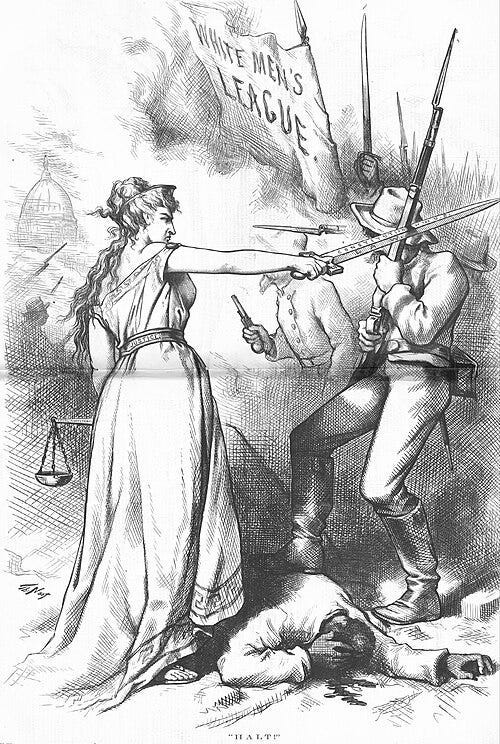
Political violence wasn’t rhetorical; it was a body count. The Haymarket bombing in 1886. The Homestead strike in 1892, where Andrew Carnegie’s man Henry Clay Frick sent an armed Pinkerton barge against his own workers and left about ten men dead. The Pullman strike, crushed by federal troops, in 1894. A president assassinated by an anarchist in 1901.
Meanwhile, the conspiracy theories ran wild — shadowy money powers, international cabals, with the antisemitic undertones you’d expect. Replacement panic was so mainstream it produced the Chinese Exclusion Act and, eventually, eugenics departments at respectable universities.
The reflex is to blame the era’s monsters, and God knows they audition for it. Jay Gould crashed the national economy trying to corner the gold market and reportedly bragged he could hire one-half of the working class to kill the other half. But here’s where I have to be honest with you, because this whole piece falls apart if I’m not: Gould, Frick, Rockefeller, Boss Tweed — they were not the disease. They were the bloom. Parasites are a constant; every era grows them to maximum greed, because that’s what parasites do.
The variable is the host.
And the American host, by the 1890s, was compromised at every level. Tammany didn’t hold a single voter at gunpoint — the ward voted for turkeys, knowingly, for decades. Lynchings drew crowds of ordinary citizens; the photographs sold as postcards at pharmacies, which is a sentence I need you to sit with. Race science filled lecture halls with respectable, churchgoing audiences. Standard Oil’s machine ran on thousands of willing clerks, legislators, and middlemen who knew exactly what they were carrying and carried it anyway.
The political scientist Robert Putnam—who spent decades measuring American social cohesion —found that the Gilded Age was the most atomized, low-trust, every-man-for-himself moment in the American record.
And yet, America survived.
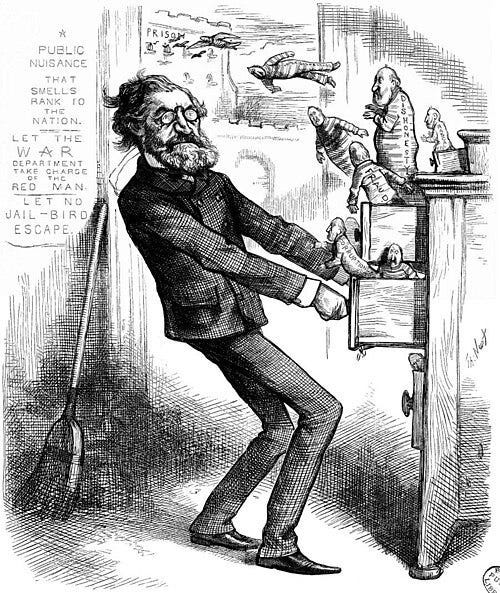


The Turnaround was the Nobodies
Then something happened that isn’t supposed to happen, and I want to be precise about what it was — because the story you know is wrong in a way that matters.
The story you know stars the trust-busters: Teddy Roosevelt swinging the big stick, Standard Oil broken up in 1911, the reform laws stacking up — direct election of senators, food and drug regulation, the eight-hour day, and eventually Social Security. All true. All late. The legislation was the lagging indicator, the fever breaking after the immune system had already been fighting for twenty years.
The actual first movers were, and I cannot stress this enough, nobodies.
Between roughly 1870 and 1920, Americans went on the greatest civic-joining spree in the country’s history — Putnam’s data show more enduring civic organizations founded in those decades than in any comparable period before or since. Unions, granges, fraternal lodges, women’s clubs, settlement houses, mutual aid societies, congregations, the PTA. Millions of people who had every reason to conclude that honesty was for suckers instead went out and found the other cooperators.
They weren’t being noble. They were being practical: alone, each of them was lunch. Together, they were a market where decency broke even.
And then the clusters grew teeth. Ida Tarbell — whose father had been ruined by Rockefeller’s schemes, so this was personal — spent years in the archives and published a nineteen-part dissection of Standard Oil in McClure’s that turned the most powerful corporation on earth into a public villain.
Upton Sinclair wrote a novel about immigrant meatpackers so revolting that food safety laws were passed within months. He aimed for the public’s heart, he said, and hit its stomach.
A young woman named Frances Perkins was having tea in Greenwich Village in 1911 when the Triangle Shirtwaist Factory caught fire across the square. She stood on the sidewalk and watched workers jump because the exit doors were locked. She spent the rest of her life converting that afternoon into policy, and twenty-four years later, as the first woman in a presidential cabinet, she drafted Social Security.
Note what did not happen. Rockefeller never repented; he died holding the largest fortune that any citizen had ever amassed — a record that stood for 109 years until this June, when an immigrant from South Africa surpassed him. Frick died hated and rich, in that order.
The parasites were not reformed, redeemed, or converted. They were outlasted — by a host that rebuilt its own immune system beneath them until the environment stopped rewarding their behavior.
That is the only mechanism, in three thousand years of receipts, that has ever moved a society back across the line. Not a savior. Not a purge. Not, I’m sorry to report, an election.
The Part You Won’t Like
So here’s where we are. The wealth curve has climbed back to its 1890 peak. Turchin’s elite-overproduction gauges are pinned in the red. Putnam’s cohesion measures have sunk back to Gilded Age depths. And Wintemute has done what no Roman census taker ever could: counted the chorus, with confidence intervals.
By the historical pattern, what follows a crossed threshold is not reform. It’s a rupture. And nothing in the record suggests we get to skip it because we’re special. The Romans thought they were special. It’s practically the load-bearing delusion of every civilization on the list.
But the record shows exactly one other thing, and it’s the thing Sallust — corrupt, exiled, guilty Sallust — did with the end of his life. He wrote it down. And for two thousand years, through the fall of the Republic, the collapse of the Empire, the plagues, and the burning libraries, a thin, unbroken chain of stubborn people copied his manuscripts by hand because they thought the indictment was worth preserving. Rome, as anyone in 40 BCE understood the word, no longer exists. You just read Sallust’s best line anyway.
The threshold is real. The arithmetic is real. And the arithmetic has exactly one input you control. Every era’s turnaround began the same way: some unmeasurable number of people, each acting alone, declined to sell — and then made the single most subversive move available to a member of a collapsing civilization.
They found the people who could not be bought.

Carlyn Beccia is an award-winning author and illustrator of 13 books. The Grim Historian is a reader-supported publication. To receive new posts and support my work, consider becoming a free or paid subscriber.